Intro to the WriterDeck
First off, let me acknowledge that the WriterDeck is both a product and an idea. I'll be covering the idea. Not because I don't believe the product is useful, but because I like tinkering so I made my own. I know the whole stack this way, and I get the Ikea Effect [1].
Let's start with the basics. What is a WriterDeck? Is it a piece of kit that you plug into the input port in your forearm and it automatically records your thoughts into words? Not yet, at least, but it does have roots in cyberdeck/cyberpunk cosplay. The idea is it's a bespoke device you cobble together (or pay someone to cobble together for you as a product) that's exclusively used for writing. And that exclusivity is the point! If you don't have the entire wild world of the internet at your fingertips, don't have emails or notifications begging for your attention, and don't have a flashy pointer hovering over the 'Games' folder in your applications menu--- [2] you write more.
Okay, I hear you ask, it's a writing device to focus your attention. But what is it? Why, it's whatever you want it to be! You got an old laptop? WriterDeck. You got a 486 gathering dust in your attic? WriterDeck! You got one of those ancient devices that the keys just transfer ink from a ribbon onto a page directly? WriterDeck! Also TypeWriter, but the point remains. Now, about my own personal WriterDeck. I've got a few single-board computers (SBCs) laying around, so I took this boy
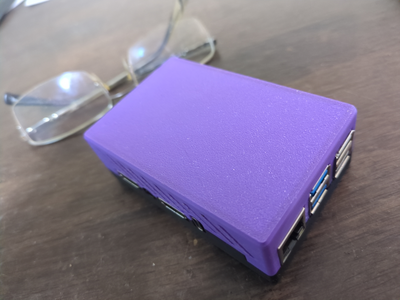
and installed armbian on it. For software, I just have kmscons, neovim, vimwiki, pelican, and ssh installed. Basic config of neovim, using mini.nvim, vimwiki, and Arborist and nothing else (I'm just interested in highlighting and syntax information for ReStructuredText and a wiki for ideas/notes). I hook it up to a usb-powered little display, a small form factor keyboard, and an Anker power brick, and I'm good to go. The monitor and keyboard fit in the main compartment of a laptop satchel, the SBC and power brick in a pocket, and it's now portable! If I want coffee while I write, I migrate to the kitchen table. If I want to not get rickets, I migrate to the bench on my patio. If the world is overwhelming and I just want to hide, I call my therapist. Then I also migrate to the bedroom.
What does it feel like? It's weird at first, I won't lie to you. I found myself hitting alt+tab a few times with some momentary confusion on why my web browser didn't magically show up. Then I got more used to it and discovered I'll want to set some alarms or timers. I've found that, once the distractions are gone, I just write. Without a status bar blinking the time at me, and without breaks to check my email (and also the time), I don't keep track of how long it's been and what else I should be doing. This post alone, I've already written and revised for (by my watch) two hours and haven't got up to get a water or coffee yet, and only realized the time expenditure when I checked to include it! By that metric, I'd say it's an undeniable success at its intended use.
Do I think everyone should do this? Probably not. If you've no interest in writing, then a bespoke writing device has no value. Do I think everyone should evaluate their hobbies and see if reducing distractions will help them achieve their goals and remember why they picked up the hobby in the first place? Absolutely! Modern social media and internet culture prioritize spending huge amounts of time doing things that don't bring joy or fulfillment, and sometimes make you angry and sad for all your spent energy. That's also why I do photography with a camera rather than my phone, and why I think visual artists would benefit from an "art deck" with just drawing software and a tablet attached to it. Because at the end of the day, doing more of what you love should be part of your goals, and doing less of what bothers you will always benefit your mental health.
| [1] | There's a measured effect where people attach greater value to things they build themselves, even when they're objectively worse for more money. Named for the flat packed furniture store for allen wrench reasons. |
| [2] | Emdash: a punctuation mark indicating that you're changing linguistic gears. Not a marker that AI wrote my post, because it didn't. AI would be far more hinged. |